
A lot of regulatory monitoring in life sciences works like this: once or twice a year someone goes through the sources that matter to the company, checks if anything relevant has changed, writes it up and files it.
It's a reasonable setup, and it's so normal that people rarely question it. I think it's doing two different jobs at once though, and it's only really good at one of them.
Regulators don't publish on your schedule
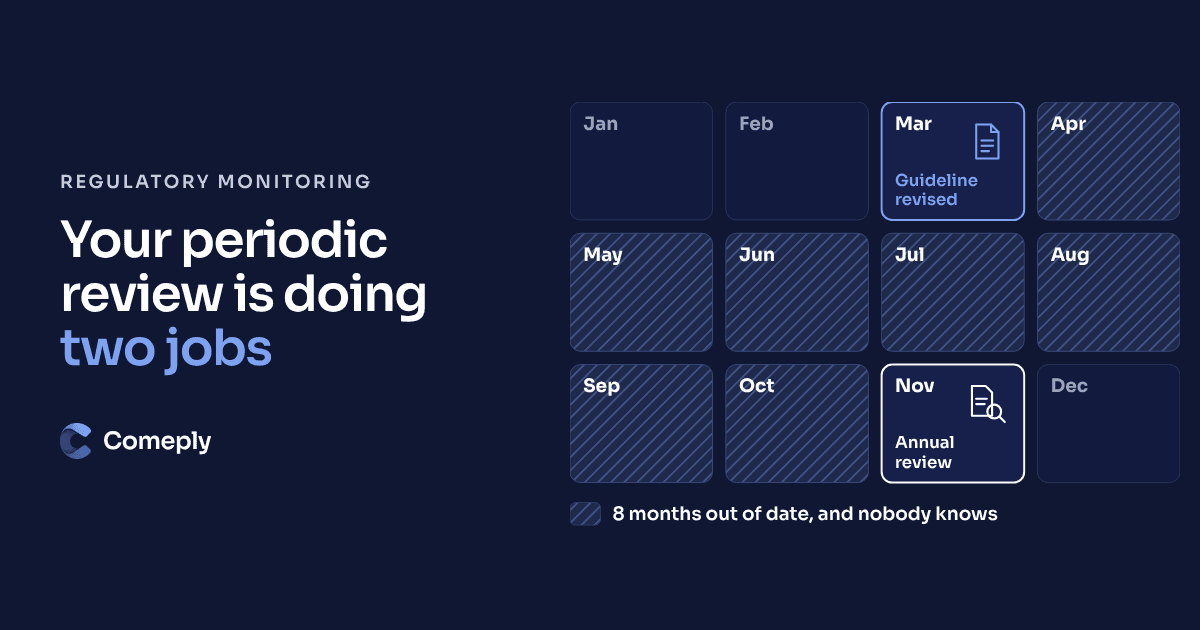
Authorities publish when they're ready. A guideline gets revised in March, a Q&A is updated in June, a draft goes out for consultation in July. None of that lines up with a review that happens in November.
So there's always a gap. If a relevant change lands in March and you review in November, your documentation is out of date for eight months and nobody in the company knows. (Eight months is just an example. The gap is whatever time there is between publication and your next review.)
Most of the time nothing goes wrong in that window, which is probably why the setup has lasted. It also makes the gap easy to ignore.
Two jobs
If you look at what the review produces, it's two things. One is finding changes. The other is a record that someone competent looked at the sources on a given date and drew a conclusion.
Both matter. An inspector will want to see that you have a process for keeping up with regulatory change and that you follow it, and the periodic review gives you that record.
It's much weaker at finding changes. Once or twice a year is too slow to catch something early enough to deal with it calmly. By the time the review spots it you're often working backwards, trying to figure out what should have happened since the change and whether anything needs fixing.
Why it can feel like a lot of work for little
When one meeting has to do both jobs, finding changes ends up on the same schedule as the record keeping. Once a year is fine for the record. It isn't fine for finding changes. I think that's a big part of why these reviews can feel like a lot of reading for an answer that comes too late.
Splitting them up
You don't need anything big to separate the two. These are the questions I'd start with:
- How would you find out about a relevant change in the week it's published, instead of at the next review?
- Who decides if a change is relevant, and how fast does it get to the people who own the affected documents?
- If changes are picked up as they happen, what is the periodic review for? Often it gets shorter and becomes a check that the ongoing process worked, which is also the kind of record an inspector wants to see.
- For any given change, can you show when you found out, what you decided and why?
None of this replaces the periodic review. It just stops it from being the only way you find out about changes.
Picking up changes close to when they're published, splitting them into requirements and keeping the link back to the source is what we work on at Comeply. I'd split the two jobs whatever tool you use, though.
If you run periodic reviews, I'd like to hear how you handle the time in between.
Regulatory monitoring
How do you handle the time between reviews?
Tell us how your periodic review works today, and we'll show you how Comeply picks up changes as they're published.
Get in touch